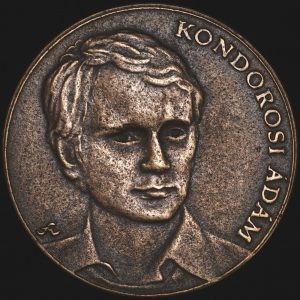
The Adam Kondorosi Academia Europaea Award
for Early Career Research 2025#
The award was presented on Tuesday 26th August 2025,
at the 16th European Nitrogen Fixation Conference
Andrew Wiles Building
University of Oxford, United Kingdom
to
Dr. Myriam CHARPENTIER (John Innes Centre, United Kingdom)#
Dr. CHARPENTIER delivered the 2025 Adam Kondorosi Lecture:
“Nuclear calcium signalling in root endosymbiosis”#
The laudation was given by Professor Eva Kondorosi, MAE
““The Adam Kondorosi Academia Europaea Early-Career Investigator Award” recognizes a young scholar for an outstanding scientific contribution.
The award consist of a diploma/medal and prize money. This prize was established in recognition of the significant achievements made in the field of plant and microbe interactions and symbiotic nitrogen fixation by the late Professor Adam Kondorosi.
Members of the Award Committee:
- Eva Kondorosi, Academia Europaea
- Sharon Long, Stanford University
- Graham O’Hara, Murdoch University
- Klaus Palme, Academia Europaea
- Ray Dixon, Academia Europaea
- Simona Radutoiu, ENFC Board
- Peter Mergaert, ENFC Board
- Luis Rubio, ENFC president (Chair)
Medal Citation#

Dr. Myriam Charpentier receives the 2025 Adam Kondorosi Academia Europaea Early-Career Investigator Award in recognition of exceptional contributions to the study of the molecular mechanisms and calcium oscillations in signalling pathways for nodulation and mycorrhization.
TITLE AND FULL NAME: Dr. Myriam CHARPENTIER
AFFILIATION: John Innes Centre , Cell and Developmental Biology Department, Norwich, United Kingdom
LINK TO WEBPAGE:
https://www.jic.ac.uk/people/myriam-charpentier
TITLE OF PRESENTATION: Nuclear calcium signalling in root endosymbiosis
ABSTRACT OF PRESENTATION:
Nutrient acquisition is a fundamental process for plant survival, directly impacting agricultural productivity and ecosystem sustainability. To overcome limitations in soil phosphate and atmospheric nitrogen availability, plants have evolved intricate strategies involving symbiotic associations with arbuscular mycorrhizal (AM) fungi and nitrogen-fixing bacteria. A hallmark of these intracellular symbioses is the induction of oscillatory calcium (Ca²⁺) signals in the nuclei of root cells, which are essential for initiating symbiotic-specific gene expression and cellular reprogramming. We have demonstrated that these nuclear calcium signals are conserved across land plant. However, calcium serves as a versatile secondary messenger in many signalling pathways. Our work further shows that nuclear calcium releases not only specify endosymbioses programs but also supports primary root development via the same nuclear calcium channels. Understanding how endosymbiont-induced nuclear calcium oscillations are encoded and decoded to establish symbiosis is essential to advancing our fundamental knowledge of calcium signalling and endosymbiotic processes in plants. Here, I will present our work and current understanding of the molecular mechanisms that allow plants to generate endosymbiosis-induced nuclear calcium signalling, and how rewiring this signalling can enhance plant-endosymbionts associations under adverse conditions.
BIOGRAPHICAL NOTE:
Dr. Myriam Charpentier is a plant molecular biologist whose research explores how plant cell nuclei process environmental stimuli to orchestrate nuclear calcium signalling. She completed her MSc in Plant Genetic and Biotechnology at the University of Paris VII, France, followed by a PhD in Plant Genetics and Molecular Biology at the Ludwig-Maximillian University in Munich, Germany. She conducted her postdoctoral research at the John Innes Centre (JIC) in Norwich, UK, in the laboratory of Prof. Giles Oldroyd. In 2017, she was awarded a BBSRC-David Phillps fellowship, which enabled her to establish her independent research group at JIC. She was appointed to JIC tenure track in 2019 and achieved full tenure in 2022.
Her research group focuses on understanding how plant cell nuclei generate and interpret calcium signals in response to biotic, abiotic, nutritional, and developmental cues. A central goal of her work is to elucidate the molecular mechanisms underlying nuclear calcium signalling in plant endosymbiotic interactions. Through this research, Dr. Charpentier aims to deepen our understanding of plant calcium signalling and its impact on plant-microbe interactions.